


The world is always changing. Just a decade ago, none of us could have imagined the huge democratisation of success where almost anyone from anywhere can become a millionaire or a celebrity if they were doing the right thing at the right place and the right time.
The trick of course is to know those three things. That right time, place and activity. What careers will be hot in a few years? What new technology will again overhaul how we connect, live and work? And most importantly, what should we be doing right now so that we have the right skills and experience to catch that next big bus when it comes?

Consider first how you got to where you are right now. You may be that rare one who always knew what they should be doing in life, but more typically, your career was decided by the marks you got in boards and what your friends and your father’s friends told you you should be doing.
And so it went on with college and career. You kept looking only one step ahead, where the others before you had gone, and followed them.
But the world kept changing around you. Not once, but twice and even three times by the time you entered mid-career. Technologies and platforms you had never dreamt possible when you were starting off. The old hierarchies broken, new modes of working and living. The most coveted careers of yesterday now stagnant and laying off by the tens of thousands.
And yet, when I was working in the NCR area more than a decade ago and considering a radical career break, the phrase I heard most often was ‘Aaj ke zamaane mein’. ‘In today’s world’. This was a world before Uber, Zomato, Zoom, AI, Covid, Netflix, Tiktok, stand-ups, and yet, everyone was certain that they knew exactly where the world was headed.
This certainty killed their curiosity. They looked at only what was trending and not what was nascent.
For here is the thing: ideas of the future look impractical, and even stupid, at the beginning. Let me cite two examples.
Working for the world’s biggest retailer at that time, I sat at a meeting where the idea of having groceries delivered to homes was deemed too costly and vetoed without even a minute of discussion. Then, a colleague got an offer from a new e-commerce startup, to head their merchandising, but he rejected it, laughing how his particular category could never be sold online. If my company had ran even a pilot of that idea then, they wouldn’t have had to buy in a few years a newfangled e-commerce platform for many billions of dollars: they would have built the business by themselves. And that colleague would be now an angel investor with the money he would have made when that startup went for its IPO.
The problem was not that they rejected the idea, one is allowed to be wrong about the future, but that they did so without much thought. They knew their today, and just extrapolated it to the future.
But the future is no longer an extrapolation: it is one disruption after another. Which is why VCs prefer young entrepreneurs when betting on the future: because they do not know enough of today to know what is not possible tomorrow.
Unfortunately, despite the radical disruptions we have seen in the past decade, I find that most people still don’t want to learn. They would rather be certain than curious. Because curiosity means leaving an opening in our view of the world, a seed of doubt, rather than the closure we seek.
Closure is always a false position. It is a trick of gestalt, the human tendency to build a complete picture from partial information. Our worldview is limited by how much we can see around us. The people we interact with, the news we get. Think again of your schooldays. When your only source of information was your peers, who were as clueless as you. Think how that world around you has expanded since. The many cultures you have travelled through within and without the country, the people you meet daily who come from vastly different backgrounds and skillsets (sales, marketing, HR, finance, tech, security, etc.), the many debates and discussions available online on the state of the world in technological, social, ecological and cultural fronts.
And yet most of us would still rather sit with people like ourselves, with mostly the same backgrounds and industries, or follow people whose opinions exactly matches what we want to see the world us. We do not invite difference in our thinking, only reinforcement.
And then the world changes once over again, not caring about our certainties, and we are again left reacting to it rather than preempting it.
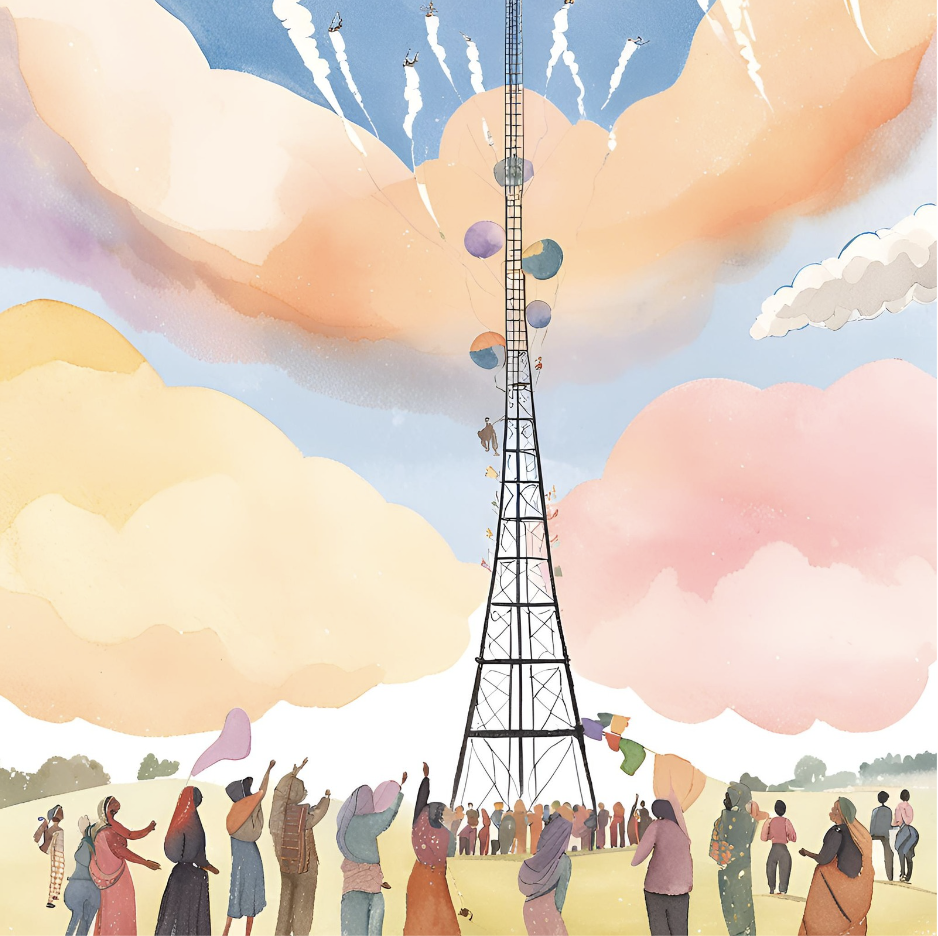
So raise your antenna higher. Receive more from the world beyond your comfort zone. As I said, you have access now to a far greater pool of ideas than you ever had, and you are wasting that opportunity if you are sitting in an echo-chamber.
Look beyond how things are – and reflect instead why they are that way. Because disruptions arrive when some factor underpinning the current reality is challenged.
Read. Not time management books but what bona fide scholars are writing from their research into the sociopolitical shifts of our time and our psychological makeup. You can google ‘Top 10 books’ on virtually any topic and even if you read 3 of them by the end of a year, you would know vastly more about the world.
Question your water. Those fundamental assumptions that you don’t even realise that they are only assumptions. This post here conducts a test to ascertain that.
Most importantly, know yourself. Most of us come from backgrounds and schooling where we never really got to consider who we are. But today we have the resources where we can. Unfortunately, we are now caught in a late-capitalist machinery which conspires to keep us perpetually busy either producing for it or passively consuming.
You are not your job, not your XUV, not your flat. You are your values, your peace and how you touch others’ lives. You are your core inner purpose, unique to you in this world, and that alone can tell you where you can really fit into the present and the future and make a real impact.
So, slow down. Silence that constant noise around you, find that time to reflect upon these questions sincerely, and believe me eventually you will start discovering them.
Carl Jung said ‘The world will ask who you are, and if you don’t know, the world will tell you’. And this is how most of us live, with the world telling us who we are and what it is.
But the world lies to us. It does not tell us that what we see of it is only a fraction of the smallest fraction, and that cataclysmic changes have begun somewhere that will upset everything we know.
And the world cannot tell us who we essentially are. This is something that we have to tell the world. That we are more than just people who follow the herd. We are ourselves.
If we know what that is strongly enough, the world will make room for us. Even bend to our will.
Raise your antenna higher.