



Be

Home Wellness Be

The Ultimate Life Hack: Stop Trying to Hack Life!

Everywhere I turn, there’s someone offering me a solution for long-standing problems of life.

Find Your True Love with these Three Easy Steps!
Say Goodbye to Procrastination Forever!
How to Self-Transform in Just Two Weeks!

The promise is as unbelievable as it is intoxicating. Problems I’ve wrestled with for 40-odd years, now supposedly solvable with a clever tip or a quick trick.
But deep down, we know how that goes.

The allure of the “hack” has infiltrated everything—our careers, relationships, even our sense of self. But where did this idea originate from?And why did it become so viral and then a cult in itself?
And, most importantly, why does it often leave us feeling more disconnected than fulfilled?


Origins: From Programming to Pop Culture

A little investigation revealed that the concept of a “hack” originated in the tech world of the early 2000s that I myself was a part of. As a back-end programmer, I often faced repetitive, tedious tasks that consumed too much time. For instance, debugging and optimising a database query would sometimes involve hundreds of lines of code — painstaking, time-intensive work. Hacks were clever shortcuts we would pick up from each other, helping us streamline such tasks, saving time and mental bandwidth.

But as the idea of a “hack” gained traction, it morphed into something far bigger than its original scope. Blogs, productivity books, and social media rebranded hacks as practical tips for all aspects of life. They promised ways to simplify not just mundane chores, like organising your desk or meal prepping, but also life’s biggest challenges: finding meaning, eliminating anxiety, and transforming oneself into a “better” person. Whatever that meant.

Life isn’t about being perfect—it’s about being present

Why Life Hacks Fail

Life hacks offer the illusion of quick solutions to complex problems. They thrive on the belief that life can be optimised, much like a piece of software. But life is not a code or gadget to be debugged. It’s messy, emotional, and deeply personal. Here’s why life hacks often fall short:

  1. They Ignore Deeper Issues
    Many hacks focus on surface-level fixes without addressing the underlying causes of our struggles. For instance:
    “Overwhelmed by your inbox? Set up auto-replies and filters!”
    But what if the real issue is your inability to set boundaries with work? Or, “Feeling unmotivated? Start your day with a cold shower!”
    But what if you’re dealing with burnout or depression? Life hacks are like applying a band-aid to a wound that needs stitches—they don’t go deep enough to truly heal.
  2. The Over-optimisation Trap The obsession with productivity has made us view every moment of our lives as something that must be optimised. We turn hobbies into side hustles, cram our schedules with self-improvement tasks, and measure our worth by how much we can accomplish. But in doing so, we often lose sight of what truly matters: rest, play, connection, and simply being.
  3. The Illusion of Control Life hacks promise control over chaos, yet much of life—relationships, health, and unforeseen events—remains unpredictable. No hack can prepare you for the messiness of human emotions or the randomness of life. And when these hacks fail, as they inevitably do, we’re left feeling more anxious and inadequate than before.

It’s about how deeply you love, how deeply you work, and how deeply you connect with yourself, others, and the world around you

Why We Keep Chasing Hacks

So why do we keep falling for the promise of life hacks, even when they often fail to deliver?

At the heart of it lies our cultural obsession with productivity and efficiency. Society has conditioned us to tie our self-worth to how much we achieve. We’re told that success is about being faster, smarter, and more efficient than everyone else.

This mindset has turned projects and careers into the central meaning of our lives. Instead of seeing them as small, manageable parts of a greater whole, we’ve deluded ourselves into thinking that life itself can be fine-tuned like a machine. If we just find the right hack, we believe, we can eliminate struggle and unlock the perfect life.

But life isn’t about being perfect—it’s about being present.

What Life Is Really About

True personal growth doesn’t come from shortcuts. It comes from slow, deliberate effort and an acceptance of life’s inherent messiness. Here’s what we often overlook in our quest for hacks:

  1. The Value of Depth Over Speed Life is not a race. It’s about how deeply you love, how deeply you work, and how deeply you connect with yourself, others, and the world around you. These things can’t be hacked; they require time, patience, and mindfulness.
  2. The Power of Rest and Play In our rush to be productive, we’ve forgotten the importance of simply existing. Rest and play aren’t luxuries—they’re essential for a fulfilling life. They nourish our creativity, restore our energy, and remind us of life’s simple joys.
  3. Embracing Uncertainty Life will always be unpredictable, and that’s okay. Instead of trying to control every aspect of it, we can learn to navigate uncertainty with resilience and grace. This means cultivating qualities like patience, self-awareness, and gratitude—things that can’t be found in a hack.

Living Beyond the Hack

So, what’s the alternative to a life full of hacks? It’s a life rooted in mindfulness and intentionality.
So in the spirit of a life-hack, I offer here four steps to embrace this approach. 🙂

  1. Take Time to Reflect: Instead of rushing to fix problems, take a step back and ask yourself what’s really at the root of your struggles. Often, the answer lies deeper than any quick fix can reach.
  2. Be patient and kind to yourself: The answers you will come with are not going to be easy to put in action. And don’t judge yourself harshly when you fail because you are working against years of conditioning, trauma, habits and personality. Change will be slow, but this trickle will become a larger flow with time and persistence. Celebrate whatever progress you make, knowing how earned even that little was.
  3. Prioritise What Matters: But you can begin with exploring and focusing on the things that truly bring you joy and fulfilment. Let go of the need to optimise every aspect of your life and make space for rest, connection, and play.
  4. Practice Gratitude: Life is fleeting and imperfect, but it’s also full of beauty. Take time to appreciate the moments, big and small, that make it worthwhile.

Conclusion: There Is No Hack for Life

I am not advising you to abandon life hacks as they can keep offering small wonderful tips to organise your desk, managing your inbox, or saving time in the kitchen. But when it comes to the deeper, more meaningful aspects of life, there are no shortcuts.

Personal growth, meaningful connections, and a sense of purpose don’t come from clever tricks or quick fixes. They come from slow, intentional living—embracing life’s messiness, navigating its unpredictability, and finding joy in the journey.

Life is not about how much you can optimise; it’s about how deeply you can live. And that’s something no hack will ever teach you.

Happiness is not the absence of unhappiness

We all want to be happy, but what that means is difficult to define. We usually define it in relation to something negative we are feeling right now. Some anxiety about the future. Emotions like jealousy, anger, or discomfort. And we tell ourselves that if we are able to get rid of this unhappy feeling, then we will be happy.
But is it really as simple as that?

Don’t try to escape unhappiness because not only is it an unavoidable fact but a part of our very nature

PANAS ( Positive and Negative Affect Schedule) is a psychological scale that measures our inclination towards two sets of emotions. The positive ones like joy, excitement and love, and the negative ones like fear, anger, jealousy, disgust, etc.
But PANAS sees these two sets of feelings existing in parallel in us at the same time. Let me illustrate that with two examples.

Imagine you have taken your child to the beach and are watching it play and have the time of its life, and you are feeling so much joy. But at the same time you are also tense that it does not go too far into the water, so much so that you cannot fully relax. So are you happy or unhappy?


Another example. Your best friend has just informed you how she finally found her soulmate and is soon getting engaged. And while you are absolutely thrilled for her, you are also thinking of how unlucky in love you have been. So again, are you happy or unhappy in this situation?
Both.

But at the same time, it is a fact that all of us are more inclined towards one set of emotions over the other because of our genetic makeup. But that still doesn’t mean that those of us more bent towards negative emotions are necessarily unhappier, because these negative emotions mix with the positive ones to define our own typical personality type – as Arthur Brooks shows in this excellent matrix he has devised.

In his categorisation, people who score very high on positive emotions and low on negative ones, are the eternal optimists who are always looking at the bright side of things. He calls them ‘Cheerleader‘.
At the opposite end are those who mull too strongly on all the sad and evil things in life. But this angst finds an outlet in their creativity, and with their finely-attuned sensitivities make them the ‘Poet‘.
Then there those who experience both positive and negative affects very highly, oscillating between extreme excitement and motivation, and then exhaustion and depression. This is the ‘Mad Scientist‘ and in fact many of today’s creative workers follow this very pattern of bursts of creative energy followed by down-time.
And then there is the ‘Judge‘, who is low on both types of emotions. That is neither do they get too excited nor too disappointed, and that gives them a cool detachment from things and allows them to see things more objectively.

This is a really useful matrix to not only understand our natural personality type, but also to understand how we can balance it better to find our sweep spot of happiness.

For example, if you are the cheerleader type, who always sees the best in everyone you meet, it’s more than likely that by the time you are in your adulthood, you have met too many people who took advantage of your trust.

But instead of allowing a deep cynicism to seep into you, you can just change your initial response to the new people you meet. That is, instead of just blindly trusting them on their words and charm, first let them prove their sincerity to you by their actions over some time. That is, exercise your Judge personality type more in the beginning, and then once you are sure of their intentions, give them all your unthrottled love.
Similarly, if you are a Judge, try to cultivate some excitement, some creativity, so that you are not always watching life from a distance but also actively participating in it.
And so on.

Our inclination towards one personality type should not mean we have a single monotonous response to everything that comes in our life

Because here’s the nub. I believe happiness is really a balance of all these personalities present in us to different extents. Our inclination towards one type over others should not mean we have a single monotonous response to everything that comes in our life.

So, if you are feeling unhappy right now, don’t look to eliminate it to find happiness. First understand where this negative feeling is coming from. What are you feeling afraid of? Or envious, disgusted, sad about? Sometimes, these feelings have a rational basis, but more often than not you’ll find that you are overreacting to a situation. And it may help here that instead of looking for it to miraculously pass, you balance it with the right PANAS personality.

For e.g., if you are feeling sleepless and all your life’s regrets are visiting you right now, bring out your Cheerleader and think of all the things you can be grateful about. Or, bring out the Poet and savour this bittersweet flavour of life that gives us beauty in pain. The whole foundation of Urdu poetry lies in this. Similarly, a Judge can help you create more distance through detachment and a Mad Scientist can drown out this passive depression with the passion of some new work.

Different remedies might work at different times, but they are all accessible to us because – as I said – we all have these personalities in us to different degrees.
So, don’t try to escape unhappiness because not only is it an avoidable fact but a part of our very nature.
Instead, discover your personality type and also try and develop the other types within you also, to to some degree.
Find that balance within you first.

Why it matters we call the glass half-full

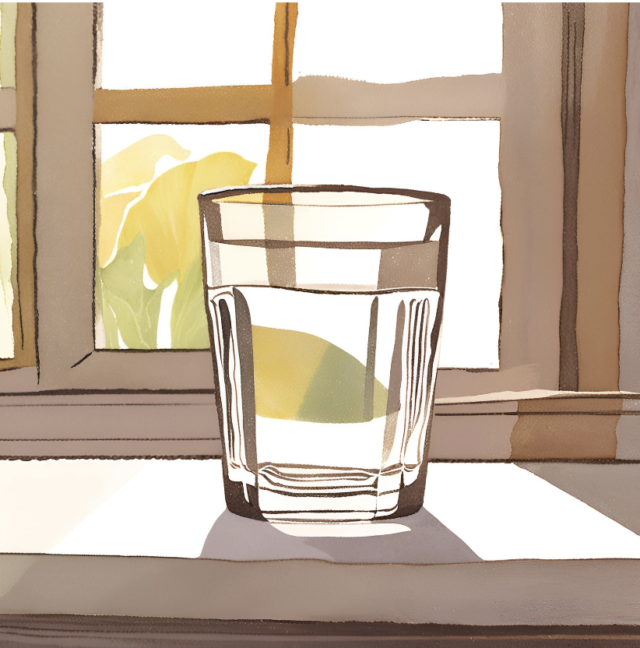
Whether we call the glass half-empty or half-full matters because it defines the direction we’re looking towards. 

Calling it half-empty means that we are measuring what is there with what is still missing in it. And calling it half-full celebrates how much is already there.

These two different outlooks reflect in the passion and perseverance we bring into anything we do.

A few years ago I was running an online channel where we broadcast interviews and panel discussions around community issues. We didn’t have enough budget to get professional anchors, but I still managed to recruit a small bunch from my theatre circle who were willing to work for a minimal fee because they believed in our content. And in no time they were improving by leaps and bounds and discovering their own unique styles.

But one of my partners did not see it that way. Right from day one, he kept complaining they were not as good as ‘Oprah Winfrey’! That is, he could only see how short they were falling, the half-empty bit. 

This thinking led to two outcomes:

Firstly, the feedback he gave them was almost entirely useless to them because it came from this imagined Oprah standard in his head, and not from where they were right now. (Imagine presenting for the first time before a really big audience, and the feedback you get is from how much better Steve Jobs was, rather than a more useful “Move across the stage a little more” or “Project your voice more”.)

Secondly, he was missing out on the journey the rest of us were having: of steadily improving with every show. He was missing out on the fun of learning.

Now extend this example to the obscene standards many of us demand of our own selves. The same two problems surface here. 

First, we are setting ourselves goals that are all but impractical. Remember the many, many times we all have promised ourselves that starting tomorrow, we’re going to overhaul our whole lifestyle. Adopt the whole seven thundering habits of highly successful people. That motivation lasts out as long as any New Year resolution: a week at the max. Because when the goals are inorganic – that is not coming from where we are right now – we are setting ourselves for failure. 

Second, it takes the fun out of learning. Instead of looking at our steady progress, we are measuring only our shortcomings. Instead of focusing on the 2-3 new things we are learning every day, we are kicking ourselves for all that we don’t know yet. We become our own hard and impatient taskmasters, and that leaves us feeling so demotivated that we ultimately drop out of the game altogether. 

Improvements are always incremental before they suddenly explode into non-linear results; sometimes so tiny we might not see them emerge for a long time. It is the law of the learning curve – and this is where a half-full attitude can make such a difference. It can give us the inspiration to persevere just long enough to reach that tipping point when suddenly change happens.

Call it optimism. Believing that things are looking good regardless of how they really are, because this belief creates its own self-reinforcing loop.

And with this optimism, what seems like a shortfall to a half-empty mindset is celebrated as a minor but significant improvement by the half-full mindset. 1% more than yesterday’s half-full. 

So wherever you are in your career, your career and personal projects, your life — stop looking forward for a while at where you want to go, and look back. See how far you have come. 

You are already half-full. 

And now look forward and go ahead with the belief that you are doing good and getting there wherever you want to go: one tiny step after another.

Find your Water – A Test

Two young fish swimming in the sea meet an older fish. The older fish asks them by way of greeting ‘How is the water?’ After he swims away, one of the younger fish turns to the other and asks, ‘What is water?’

David Foster Walter told this simple parable in his famous commencement speech at Kenyon College to highlight how we all swim in our own tanks without realising we are in one. He was referring to all the core beliefs deciding our life choices, that are so sum total for us that we don’t even realise that they are working on us.

So, I want you to do an exercise.
In the statements listed under each category below, tick the ones that strike you on first sight as uncontested truths. Just that first impression of 2-3 seconds.
Before you start, one thing: all of these statements contain a lot of truth; so don’t feel ashamed if you identify with them completely. Just try to be completely honest with yourself and see how deep your water goes.

How you measure time

1. I want to be present more for my children, partner, fast-ageing parents – but there is not enough time. 

  1. 2. I want to take out more time for myself, do things pending in my mind for so long, catch up with friends I haven’t met since ages – but again: not enough time.

3. The way to stay in control in life is to have a handle on everything happening around me.

4. There is only one way to get the best of everything in life and that is better time management.


How our world and lives need to be organised

5. The key to a successful life are productivity and efficiency.

6. We’re all in a rat race, whether we like it or not. That’s the only way to survive.

7. People work only for incentives, and those incentives have to be tangibly real.

8. The value of anything is ultimately decided by the market. It should at least have some tangible impact.

9. The worth of anyone is largely decided by their position, title, and wealth.


How to succeed in life

10. Fostering competitive spirit in our kids is a must.

11. Nice guys (and girls) finish last. 

12. Values like ahimsa made Indians weak and less competitive.

13. Hustle is the only way to survive and thrive in today’s world.

14. It’s wiser to be pragmatic and survive, than to stick to our conscience in a losing cause.

How to have a fulfilling life

15. The more likes I have, the more people who follow me, the more worthy I feel.

16. Life has to be treasured in moments, and those moments have to be captured so we can relive them later.

17. I need to connect with my inner being so that I can perform better in life and socially.

18. If I do something, it has to be something I can tell others about now or in the near to mid future.

19. Self-worth comes from proving yourself to the world. 

20. I have to go through a bucket-list of things to do before I die.

21.I have to stay up to date on current news and trends.

22. My purpose in life is to self-actualise.


So, how deep is your water?


Score 1 for every statement you tick-marked, and see below where you stand:

0-9: You know quite well the edges of your tank

10-15: Okay, you have sometimes come up against the glass

16-22: What water?

Also, note which categories you score especially high on.


As I said, these are all statements with lots of truth in them. But I want you to recognise for yourself how deeply you take some of them as the “whole truth”. Because when a thing becomes so obvious to us that we can no longer see it, we forget we have a choice.

Seeing our water does not have to mean we no longer choose to swim in it. But it can still —

1. Lead us to change some things in it that we’re unhappy about, but see right now as unavoidable sacrifices towards greater goals.

2. Broaden the spectrum of choices we are exercising in our lives, especially at the most fundamental level.

3. Make us begin to explore beyond our water, to find a more natural fit for us. Ways of living and being that are closer to who we fundamentally are.

4. At the very least, it can help us make peace with ourselves. Sometimes we do not get to choose our water. But recognising it can still liberate us, for we can realise that the fault is not in us but the circumstances imposed on us by life. We have not failed on some universal metrics, just the ones that were not built entirely for us. Hence, instead of being ashamed of our failures, we can clap ourselves on our backs for still persisting – and doing the best we can.


If you want to share your scores and thoughts from this exercise, you can reach me at ownyourstory.in@gmail.com. Hearing back from people whose lives I touch even in the smallest way is my greatest reward. 🙂

Popular Posts

My Favorites

When life forces you to make a U-turn

We are so afraid of hitting that wall where our best-laid plans come to halt.I hit such a wall into my thirties. After three...